
A buyer opens a carton of so-called eco carrier bags and hits two problems inside a week. The print smears at the seal, and a stack left near a warm loading dock fuses into one solid block. The supplier's datasheet says "biodegradable". Nobody can say what it biodegrades into, how quickly, in which environment, or against which standard it was ever tested.
That gap is the entire subject. Compostable and biodegradable materials are real, well-standardised product categories, but the words printed on the box are not the specification. The specification is a standard number, a certified thickness range, a named end-of-life environment, and a test report that matches the film you actually bought rather than the pellet the converter bought.
Here is the conclusion before the reasoning: buy "compostable" only when a recognised certificate names the product and the disposal environment, and treat "biodegradable" as a material property that needs its own qualification. The rest of this article explains how those two claims differ in law and in the laboratory, which polymers deliver them, where each one fails in practice, and which checks protect a purchase order from turning into a returns claim.
Most confusion in this category comes from mixing up two unrelated questions. The first is where the carbon came from, which is what "bio-based" describes. The second is what happens to the product after use, which is what "biodegradable" and "compostable" describe. A material can be plant-derived and non-degradable, or fossil-derived and fully biodegradable. Neither combination is a contradiction.
Compostable is the narrower and stronger claim. It means the item disappears within a defined composting cycle, leaves no visible or toxic residue, and supports plant growth in the finished compost. Biodegradable is broader: it says microorganisms can break the material down, but says nothing about how long that takes or whether the environment needed is a compost heap, a soil trench, a river bed, or a landfill cell.
| Claim | What it actually describes | Evidence to request | Typical misuse |
|---|---|---|---|
| Bio-based | Feedstock origin only: the carbon is recently plant-derived, not fossil | Biobased carbon content report to ASTM D6866 or EN 16640 | Printed on drop-in resins that are not degradable at all |
| Biodegradable | A material property; conversion by microorganisms, with no universal timeframe | Test report naming the standard, medium, temperature, duration and percentage conversion | Used alone, with no environment and no time limit attached |
| Compostable (industrial) | Biodegradation plus disintegration plus ecotoxicity plus chemical limits, in a managed composting cycle | EN 13432, ASTM D6400 or ISO 17088 certificate with licence number and product scope | Certificate covers a 20 micron film while the buyer orders 40 micron |
| Home compostable | The same idea at ambient temperature, with a longer timeframe | OK Compost HOME, NF T51-800 or AS 5810 certification | An industrial-only certificate presented as garden-compostable |
The fifth term that turns up in quotes is "oxo-degradable". It describes a conventional polyolefin with a pro-oxidant additive that makes it fragment. Fragmentation is not biodegradation, and the European Union has moved to restrict these materials under its single-use plastics rules. If a supplier offers oxo-degradable film as a compostable alternative, the conversation is over.
Biodegradation is a process, not a grade. Microorganisms convert polymer carbon into carbon dioxide, water and biomass, and the rate depends on the polymer backbone, crystallinity, surface area, temperature, oxygen availability, nutrient balance and the local microbial population. A 15 micron film and a 3 mm injection-moulded part made from the same resin can behave like different materials, because the second one has a far smaller surface-to-mass ratio.
That is why serious standards test the finished article at its intended thickness, not just the resin. They also measure mineralisation rather than mass loss. A film that loses 60 percent of its weight in a soil burial test may simply have fragmented or leached additives, leaving polymer residue behind. The thresholds in compostability standards exist precisely to rule that out: the carbon has to leave as carbon dioxide, and the residue has to pass a sieve and a plant growth test.
Watch for three specific weak claims when comparing quotes.
Compostability is assessed on four pillars, and a product must pass all four before any certificate is issued. The first is chemical characterisation: the material is screened for heavy metals and other regulated substances, and the organic carbon content is documented. The second is biodegradation, usually measured as carbon dioxide evolution in a controlled composting test. The third is disintegration, a physical test showing the material breaks down far enough to pass a sieve. The fourth is ecotoxicity, normally a plant growth test on the resulting compost, sometimes supported by earthworm testing.
The numbers behind those pillars are what make the claim auditable. Under EN 13432, at least 90 percent of the organic carbon must be converted within six months, at least 90 percent of the material must pass a 2 mm sieve after twelve weeks, and the compost must show no adverse effect on plant growth. ASTM D6400 sets the same 90 percent biodegradation target within 180 days, with disintegration assessed over twelve weeks. A supplier who cannot produce a certificate with a licence number, a validity date and a product description that matches your order has not passed those tests, whatever the datasheet says.
| Standard | Region | Applies to | Headline requirements |
|---|---|---|---|
| EN 13432 | European Union | Packaging recoverable by composting | 90 percent biodegradation within 6 months; 90 percent disintegration through a 2 mm sieve in 12 weeks; ecotoxicity and heavy metal limits |
| EN 14995 | European Union | Plastics generally, outside packaging | Same four-pillar framework as EN 13432 |
| ASTM D6400 | United States and Canada | Plastics designed to be composted in municipal facilities | 90 percent biodegradation within 180 days; 90 percent disintegration within 12 weeks |
| ISO 17088 | International | Compostable plastics | Aligned with the EN and ASTM framework |
| AS 4736 | Australia | Industrial composting, including plastics | Comparable thresholds with an added earthworm ecotoxicity test |
| NF T51-800, AS 5810, OK Compost HOME | France, Australia, international scheme | Home composting | Lower temperatures and a longer timeframe, typically up to 12 months |
Two practical points follow. First, industrial and home compostability are separate certifications, and most packaging on the market is certified for industrial conditions only, where the pile reaches 55 to 60 °C. Second, certification attaches to a product and a thickness, not to a polymer family. A converter who changes film gauge, adds a pigment masterbatch or switches an adhesive can invalidate the scope of the certificate without noticing. That is why buyers should read the certification and quality documentation behind a supplier's claim rather than the claim itself, and why a documented certification and honours record is a more useful negotiating document than a logo on a brochure.
Almost every compostable product on the market is built from one of four chemistry families, usually blended. Knowing which one you are buying tells you more about performance and end of life than any marketing description.
PLA is produced by fermenting plant sugars to lactic acid and polymerising it. It is stiff, transparent and prints well, which makes it popular for cups, cold-food containers and rigid thermoformed packaging. Its weaknesses are equally well known: a glass transition temperature around 55 to 60 °C limits hot-fill use, it is brittle without modification, and standard grades need the thermophilic conditions of an industrial compost facility to break down in a reasonable time.
PBAT is a flexible, tough, fully biodegradable aromatic-aliphatic copolyester and is the workhorse of compostable film. It is popular precisely because it behaves a little like low-density polyethylene on a blown film line: good elongation, good drawdown, workable seals. PBS and PBST sit nearby in the same family, with higher stiffness and melting points in the region of 115 °C depending on grade. Most commercial compostable films are blends, with PBAT supplying flexibility, PLA or starch supplying stiffness and cost balance, and a compatibiliser holding the phases together.
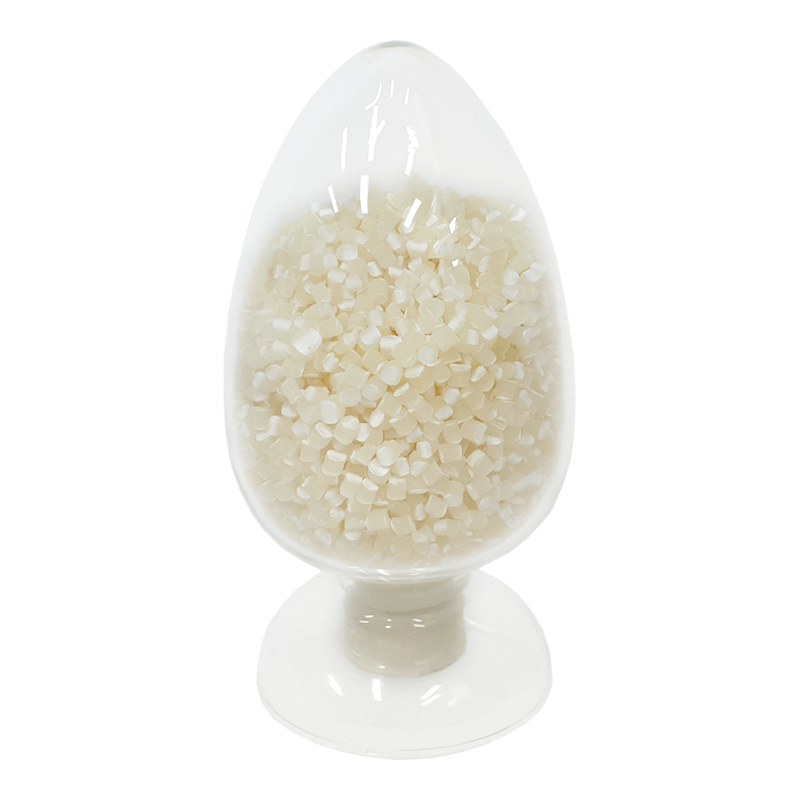
 PBAT Fully Biodegradable Polyester for Flexible Film ApplicationsFlexible biodegradable copolyester for packaging films and bags, relevant where converters need toughness and tear resistance in film applications.View Product →
Because PBAT is soft, it is also the grade most often adjusted for a specific application. A shopping bag needs tear strength and printability, a mulch film needs controlled UV behaviour, and a food wrapper needs grease resistance, so converters rarely buy a single generic grade across a whole product range.
PHA is produced microbially rather than chemically, and some grades are certified home compostable, including in soil and marine environments. It is genuinely interesting for applications where the waste will not reach an industrial facility. The constraints are cost, available volume and moisture sensitivity during processing, so PHA tends to appear in premium or niche products rather than high-volume commodity film.
Thermoplastic starch blended with PBAT or PLA is one of the cheapest routes to a compostable film, and starch-based loose-fill and thin film are well established. Starch is moisture sensitive and loses mechanical performance in humid storage, so the blend ratio and the barrier layer matter more than the headline "plant-based" claim. Cellulose-based materials, including some cellulose acetate grades, are compostable in specific formulations only; the family name is not the guarantee.
Bio-attributed polyethylene and polypropylene, including the bio-based resin routes now offered by materials suppliers, reduce fossil carbon without changing end-of-life behaviour: they are still conventional polyolefins and are not compostable. That is a legitimate sustainability story for durable goods and recyclable packaging, but it must never be sold under a compostability claim. Keeping those two product lines separated in your own purchasing documents prevents an expensive mix-up at the label printer.
The right question is never "which compostable material is best" but "which certified material survives my filling line, my customer's use, and the waste stream it will realistically enter". Four application groups cover most purchasing decisions.
Shopping bags and drinks carriers need load-bearing strength at low gauge, reliable heat sealing at speed, and print quality that survives rubbing in a wet shopping trip. Density is the hidden cost here: compostable polyesters sit around 1.24 to 1.26 g/cm³ against roughly 0.92 for polyethylene, so a kilogram of resin yields about 25 to 30 percent less film area at the same thickness. Any price comparison that ignores yield will understate the real cost per bag.
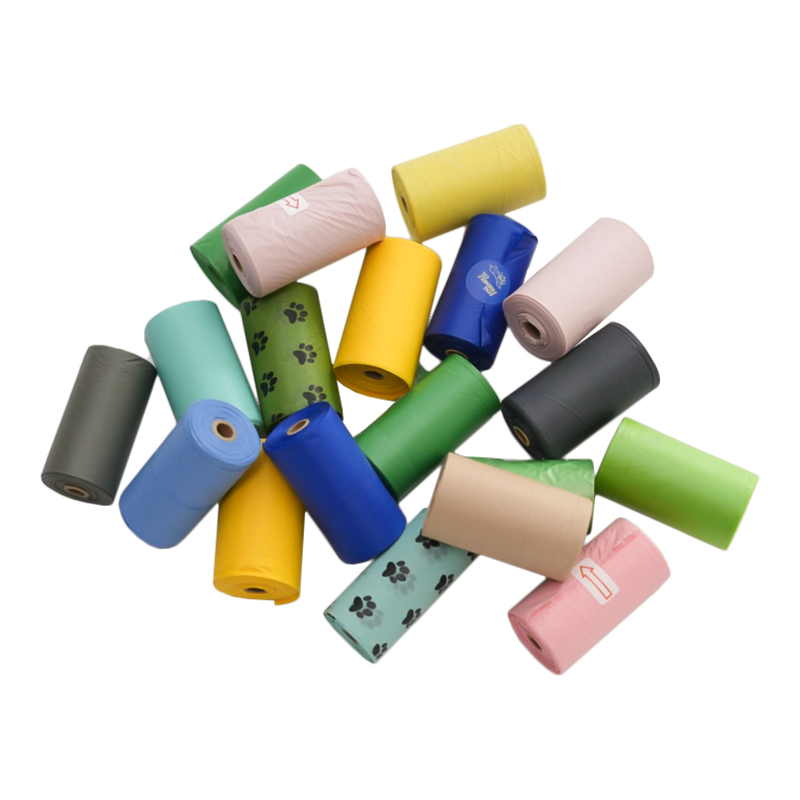
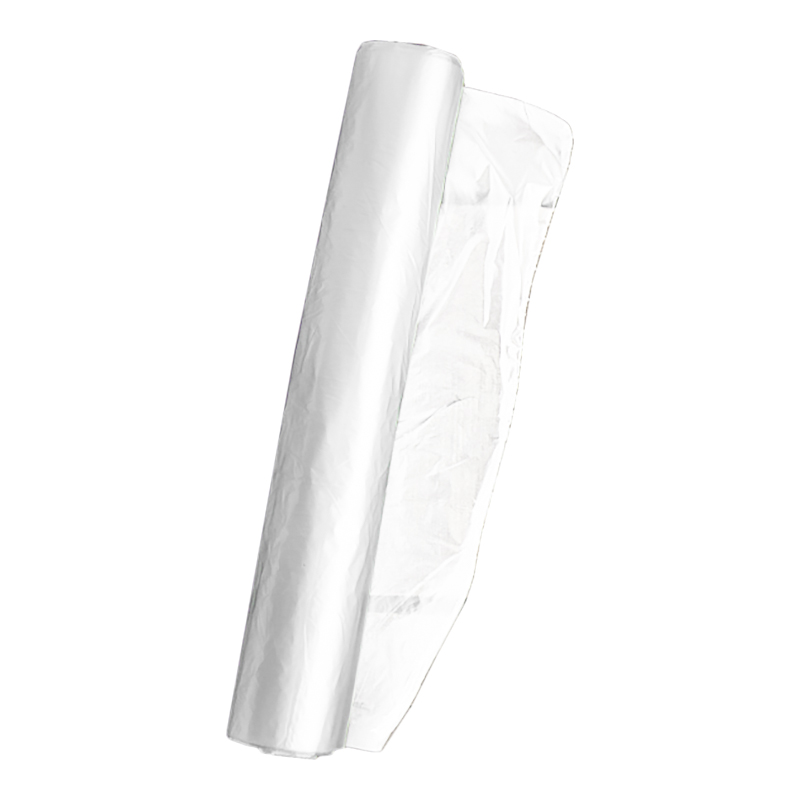
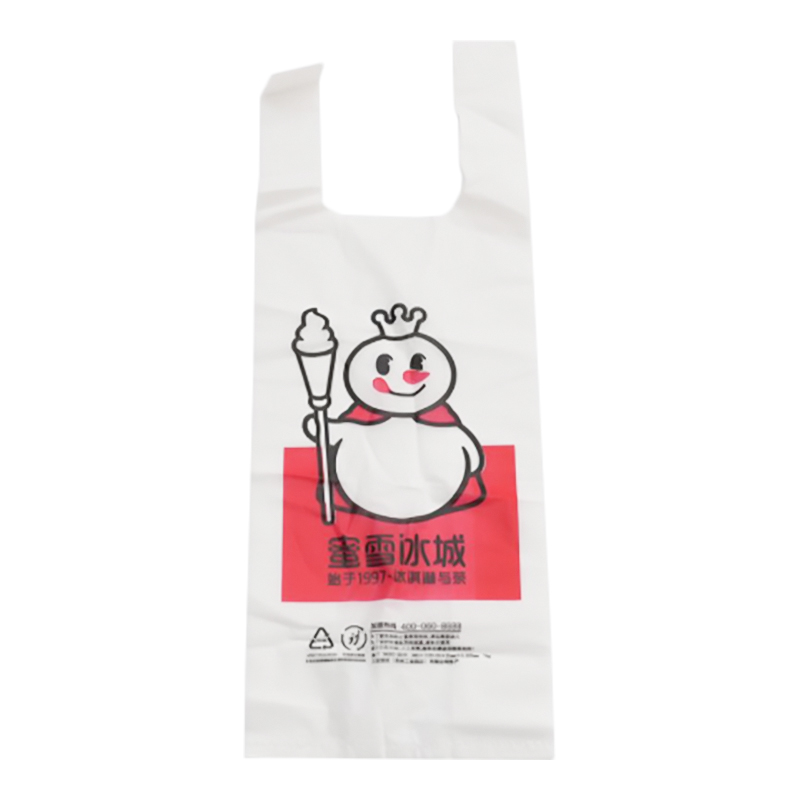 BIO/M-2501A Biodegradable Film Material for Shopping and Milk Tea BagsFood-contact biodegradable film-bag material for shopping and milk tea bags, offering tensile strength and durability for daily packaging use.View Product →
Grade selection within this group matters as much as the family. A carrier for hot drinks needs heat resistance and a stable seal at the base; a general retail bag needs puncture resistance and consistent roll width so the bag-making machine does not stop every twenty minutes.
Containers, wrappers, liners and cutlery face the tightest combination of requirements: legal compliance, grease and water resistance, and enough heat tolerance for the food being served. A material that passes compostability testing but fails a migration test at 70 °C for two hours is not a food packaging material, whatever its end-of-life credentials.
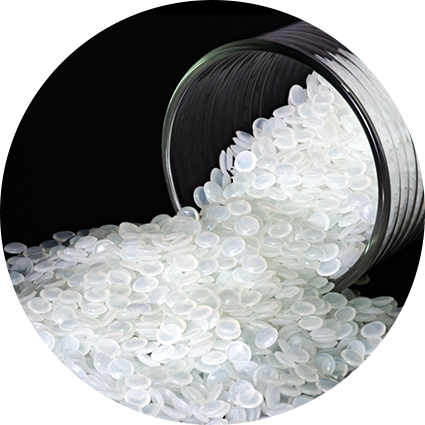
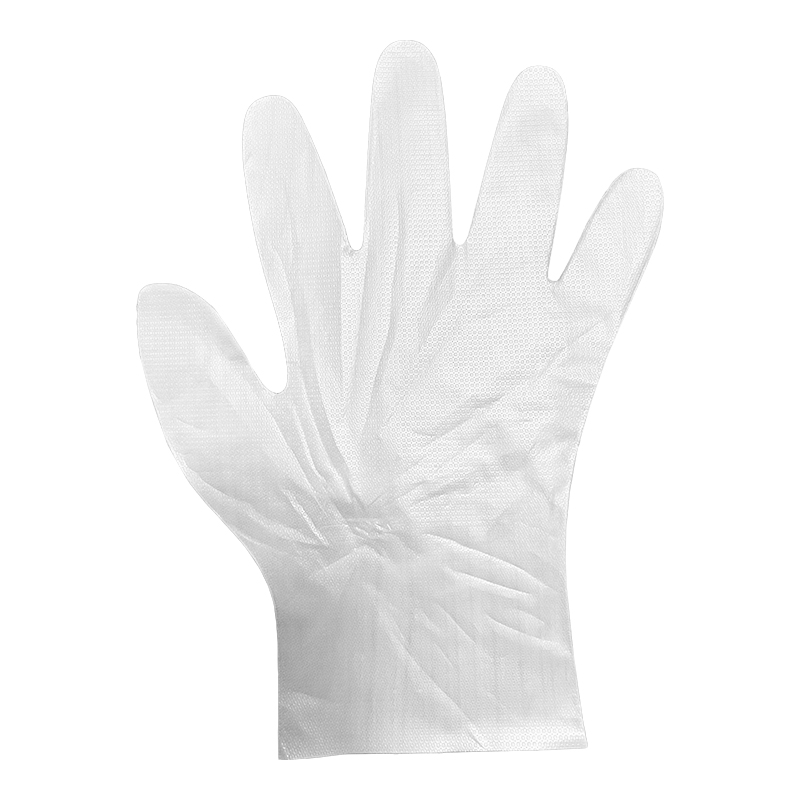 BIO/M-2206 Waterproof and Oil-Proof Biodegradable Food-Contact MaterialFood-contact biodegradable material with waterproof and oil-proof performance for lunch boxes, tableware and bags; designed for complete decomposition in 180 days.View Product →
Mulch film has to survive a full growing season of UV, soil moisture and mechanical tension, then degrade in the field without leaving fragments in the topsoil. Induction periods are engineered through stabiliser packages, and the specification should state the required functional life in weeks, not simply "biodegradable". A film that fails at week eight costs a grower far more than the film price.
Stretch, wrap and void-fill applications are usually the last to convert, because the performance bar is high and the waste stream is often controlled by the factory itself. That controlled environment is also the argument in favour: an industrial site that already segregates waste can send certified film to an industrial compost facility with far less risk of contamination than a household does.
Compostable materials are not drop-in equivalents for polyolefins, and the differences show up in predictable places. The table below gives typical ranges rather than exact figures, because grade and blend design move these numbers considerably.
| Property | LDPE reference | PLA | PBAT | Starch-rich blend |
|---|---|---|---|---|
| Density | About 0.92 g/cm³ | About 1.24 g/cm³ | About 1.25 g/cm³ | About 1.2 to 1.3 g/cm³ |
| Stiffness | Low | High | Low | Medium |
| Elongation at break | High | Low, a few percent | Very high | Medium |
| Heat resistance | Softens around 80 to 90 °C | Deflection near 55 °C | Moderate, can turn tacky | Limited |
| Moisture sensitivity | Low | Medium | Medium | High |
| Film area per kilogram | Reference | Roughly 25 to 30 percent lower | Roughly 25 to 30 percent lower | Lower still in dense blends |
Three practical consequences follow from those numbers. First, sealing windows are narrower. Compostable films often seal at lower initiation temperatures but are more sensitive to dwell time and pressure, and a line optimised for polyethylene will need its profile re-tuned rather than simply rerun. Second, printing requires surface energy management. Corona treatment to roughly 38 to 40 dyn/cm before printing is normal, and the treatment decays over time, so film that sits in a warehouse for months may print poorly even though it ran well on day one.
Third, storage is part of the specification. Compostable film absorbs moisture, and moisture plus warmth plus stack pressure produces blocking. A realistic storage clause reads something like: keep below 30 °C, below 65 percent relative humidity, away from direct sunlight, use within twelve months of production, and rotate stock. Buyers who skip that clause often blame the resin for what was really a warehouse problem.
Tolerance setting is the other discipline worth adopting early. Specify gauge tolerance explicitly, for example plus or minus 8 percent on nominal thickness, along with minimum seal strength, minimum dart impact and a maximum curl figure. Without those numbers, a supplier can meet the compostability standard and still deliver film that will not run.
Compliance is a separate track from compostability, and passing one does not imply the other. In the European Union, food contact materials fall under the framework regulation EC 1935/2004, with plastics covered by regulation EU 10/2011, which sets an overall migration limit of 10 milligrams per square decimetre of surface area and individual limits for specific substances. In the United States, the equivalent route runs through FDA clearances, food contact notifications and the relevant sections of 21 CFR.
What that means in a purchase order is simple: ask for a declaration of compliance that names the material, lists the substances with restrictions, and states the tested conditions of use. Then check that the conditions match reality. A declaration validated for 4 hours at 20 °C does not cover a takeaway container filled with hot curry and closed for 45 minutes. Worst-case testing for fatty foods, hot fill or long freezer storage is where most non-compliant projects quietly fail.
Biodegradable polyesters add two specific considerations. Hydrolytic stability matters at high temperature and humidity, so a hot-fill application should be validated for mechanical integrity as well as migration. And additives such as slip agents, anti-block and pigments must appear in the compliance documentation, because a masterbatch added at the converting stage can pull the finished article out of scope even when the base resin is fully approved.
The following sequence is the one that consistently separates genuine supply from optimistic supply. It is written for a buyer placing a repeat order, not for a laboratory.
Compostable materials generally cost more per kilogram than conventional polyolefins, and the gap widens at the finished-product level because of the density penalty on yield and the narrower processing windows. Two further factors complicate budgeting. Feedstock for these polymers is tied to agricultural cycles and to a small number of producers, so quarterly price movement is normal rather than exceptional. And because capacity is concentrated, lead times stretch quickly when a large brand announces a conversion.
A realistic commercial plan therefore does three things. It benchmarks cost per thousand bags or per square metre of film rather than per kilogram, so the density effect is visible. It hedges grade selection, using a certified blend where a premium single polymer is not required by the application. And it places trial quantities with clear acceptance criteria, so a rejected lot can be traced to a measurable parameter rather than a general complaint about quality.
Supply stability also depends on how closely the material supplier works with converters. Grades developed around a specific application, such as a heat-resistant film for hot drinks carriers or a high-seal flat bag for waste collection, remove much of the trial-and-error cost from the converter's line. That is the practical value of a materials development and application testing capability: not the promise of a miracle polymer, but a formulation that arrives with processing windows already mapped.
Compostable and biodegradable materials reward buyers who separate claims from evidence. Compostable is a certified, testable promise tied to a named environment and a named thickness. Biodegradable is a material property that must be qualified by medium, temperature and timeframe before it means anything in a contract. Bio-based describes carbon origin and says nothing at all about end of life.
The practical order of operations is straightforward: define the end-of-life route first, choose the polymer family that matches the application and the available waste infrastructure, then verify the certificate scope against the gauge you are ordering. Test seal, print and storage behaviour on your own line before volume commitment, and write the storage clause into the agreement rather than assuming it.
Done that way, the carton that arrives at the loading dock comes with a licence number, a matching test report and a film that survives a warm warehouse. That is a far better position than a datasheet with a leaf on it.




+86 18101032584
No. 60-1, Jichuan East Road, HailingIndustrial Park, Hailing District, Taizhou City.


Copyright© Taizhou Huangyan Zeyu New Material Technology Co., Ltd. All Rights Reserved.
 Custom Fully Degradable Raw Material Manufacturers


 English
 Français
 Español
 Deutsch
 italiano